
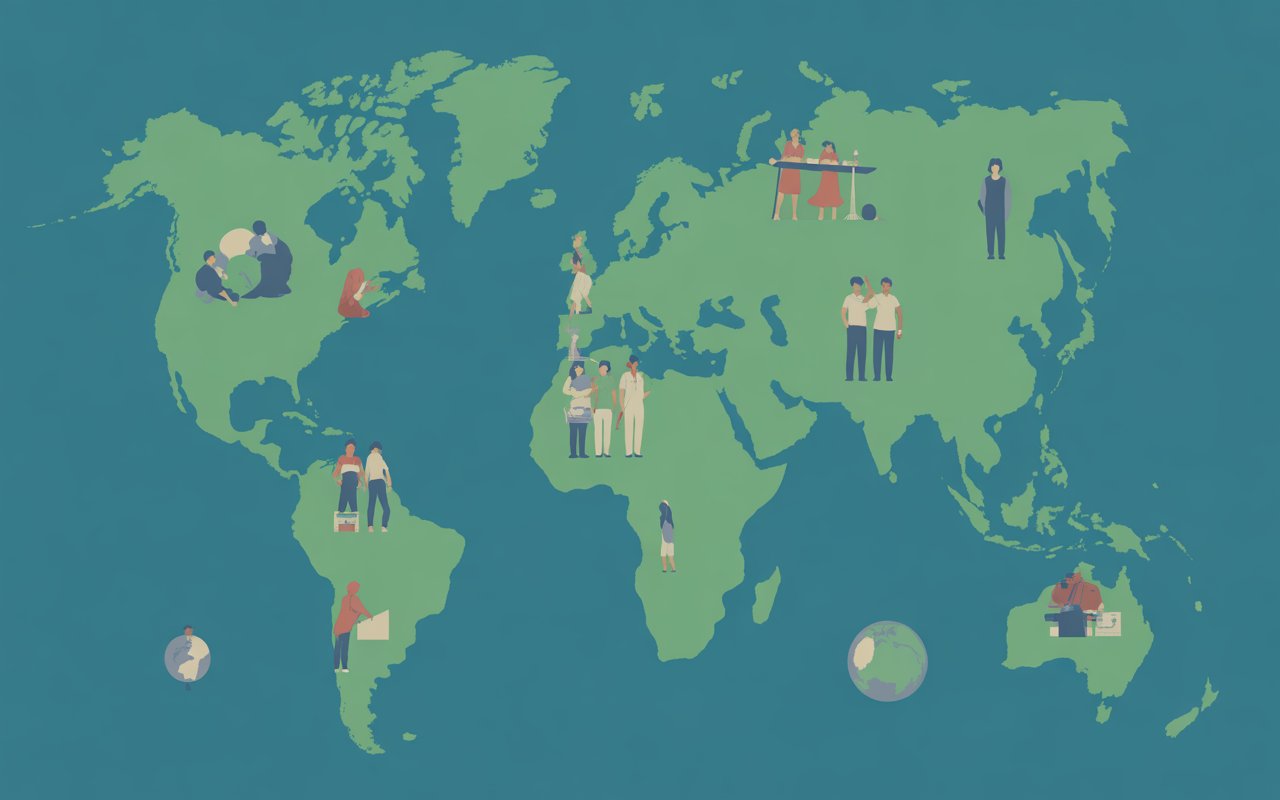
Have you ever looked at a world map and wondered why cities develop where they do, or why cultures form unique patterns across continents? That’s exactly the kind of curiosity AP Human Geography inspires. It’s not just about memorizing maps or country names — it’s about understanding how people interact with spaces, shape their environments, and build the cultural landscapes we see today.
In this article, we’ll take a comprehensive journey through the key concepts of this subject, using simple language, relatable examples, and a conversational tone. Whether you’re a curious reader, a student, or simply someone who loves learning about the world, this guide will make complex ideas feel refreshingly clear.
Understanding the Basics
What Is Human Geography?
Human Geography focuses on the relationship between people and their environments. Unlike physical geography, which deals with landforms, climate, and ecosystems, human geography explores how humans organize space and society — from cities and cultural practices to migration trends and political boundaries.
Imagine looking at Earth as a living canvas. Physical geography paints the background — mountains, rivers, deserts — while human geography adds the vibrant brushstrokes of culture, economy, politics, and movement.
Why AP Human Geography Matters
The AP (Advanced Placement) course gives high school students an early taste of college-level learning. But beyond the classroom, this subject sharpens your ability to analyze global issues critically, understand population trends, and recognize cultural patterns that influence everything from urban planning to international relations.
The Building Blocks of Human Geography
1. Geographic Concepts and Tools
To understand people and places, geographers use several tools and concepts. These include:
-
Maps: Not just for directions — they reveal spatial patterns and relationships.
-
GIS (Geographic Information Systems): Digital tools that layer data to analyze real-world problems (like tracking disease spread or mapping traffic congestion).
-
Scale: Looking at phenomena locally, regionally, nationally, or globally.
-
Spatial Analysis: Studying how things are distributed and why.
Think of these tools like a detective’s kit — each one helps solve a piece of the puzzle about human activities.
Patterns of Human Settlement
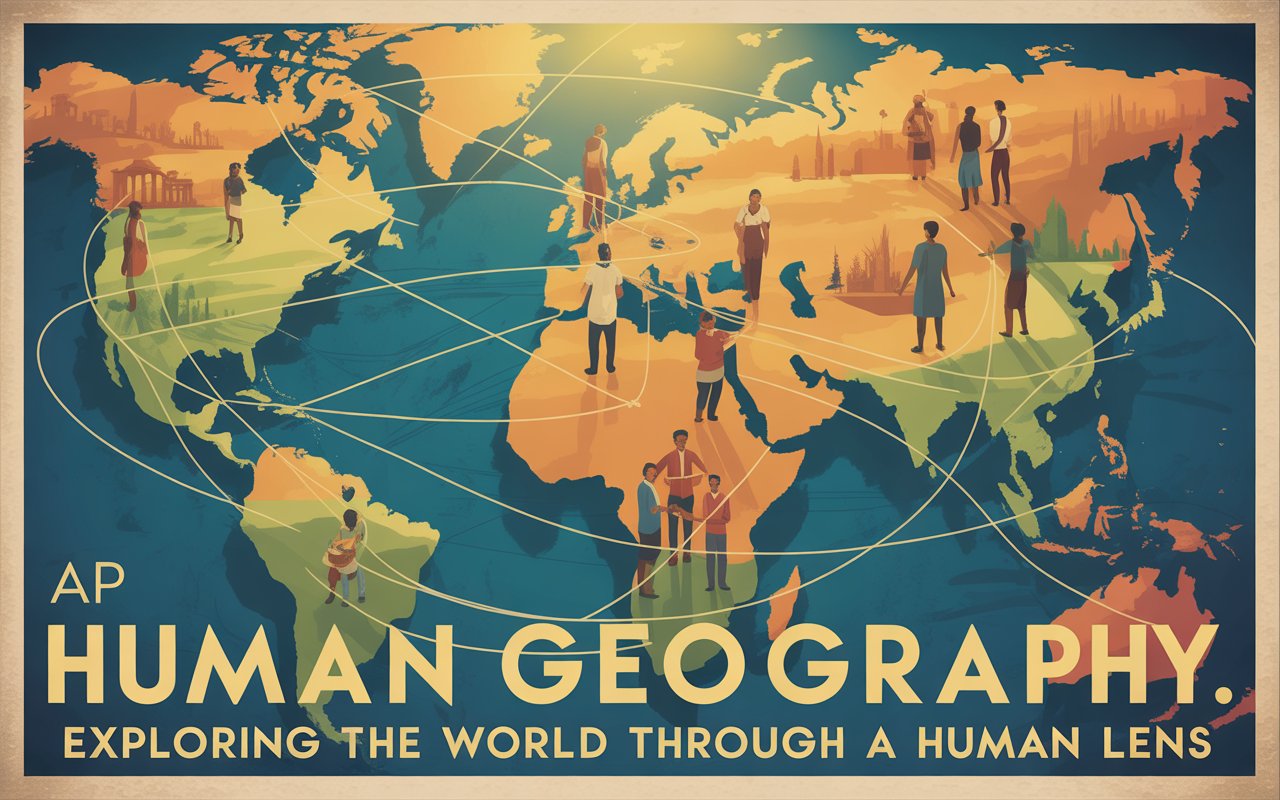
2. Population and Demographics
Population geography examines where people live, how populations grow, and what demographic patterns emerge. Key concepts include:
-
Population Density: How many people live in a specific area.
-
Carrying Capacity: How many people an area can support sustainably.
-
Demographic Transition Model: A framework that explains population changes over time — from high birth and death rates to lower ones as societies develop.
For example, countries in Europe are in the later stages of this model with aging populations, while parts of Africa are experiencing rapid growth, influencing everything from healthcare to urban development.
3. Migration and Movement
Humans have always been on the move — for better opportunities, safety, or resources. Migration can be voluntary (like moving for a job) or forced (like fleeing conflict). It shapes cultural identities, labor markets, and even language patterns.
Think of migration like rivers flowing across a landscape — they change the terrain over time, creating new paths and influencing what grows around them.
Cultural Landscapes
4. Culture and Identity
Culture includes the beliefs, behaviors, languages, and traditions that define a group of people. Human geographers study how cultures spread, interact, and sometimes clash. Some key concepts:
-
Cultural Diffusion: How cultural traits spread from one place to another.
-
Acculturation and Assimilation: How cultures blend or adopt new traits.
-
Cultural Hearths: Regions where significant cultural traits originated.
For instance, the spread of the English language worldwide can be traced back to colonial history and globalization.
5. Religion and Language
Religion and language are core elements of cultural identity. Geography examines where different religions originated, how they spread, and how they influence landscapes — like temples, mosques, churches, and sacred spaces. Similarly, language families reveal historical migrations and cultural connections.
Political and Economic Spaces
6. Political Organization of Space
Political geography looks at how power and territories are organized. This includes:
-
Nation-states and their boundaries.
-
Colonialism and imperialism and their lasting effects.
-
Geopolitical conflicts, alliances, and supranational organizations (like the EU or UN).
Borders aren’t just lines on a map — they’re living boundaries that influence trade, migration, and cultural exchange.
7. Economic Development and Industry
Economic geography focuses on how wealth and resources are distributed. It studies agricultural patterns, industrial growth, trade networks, and levels of development.
For example:
-
Core-periphery theory explains how developed “core” regions dominate global trade, while “peripheral” areas provide resources and labor.
-
Industrial zones often cluster around transport hubs, like ports and railways, shaping urban growth.
Shaping the Urban Environment
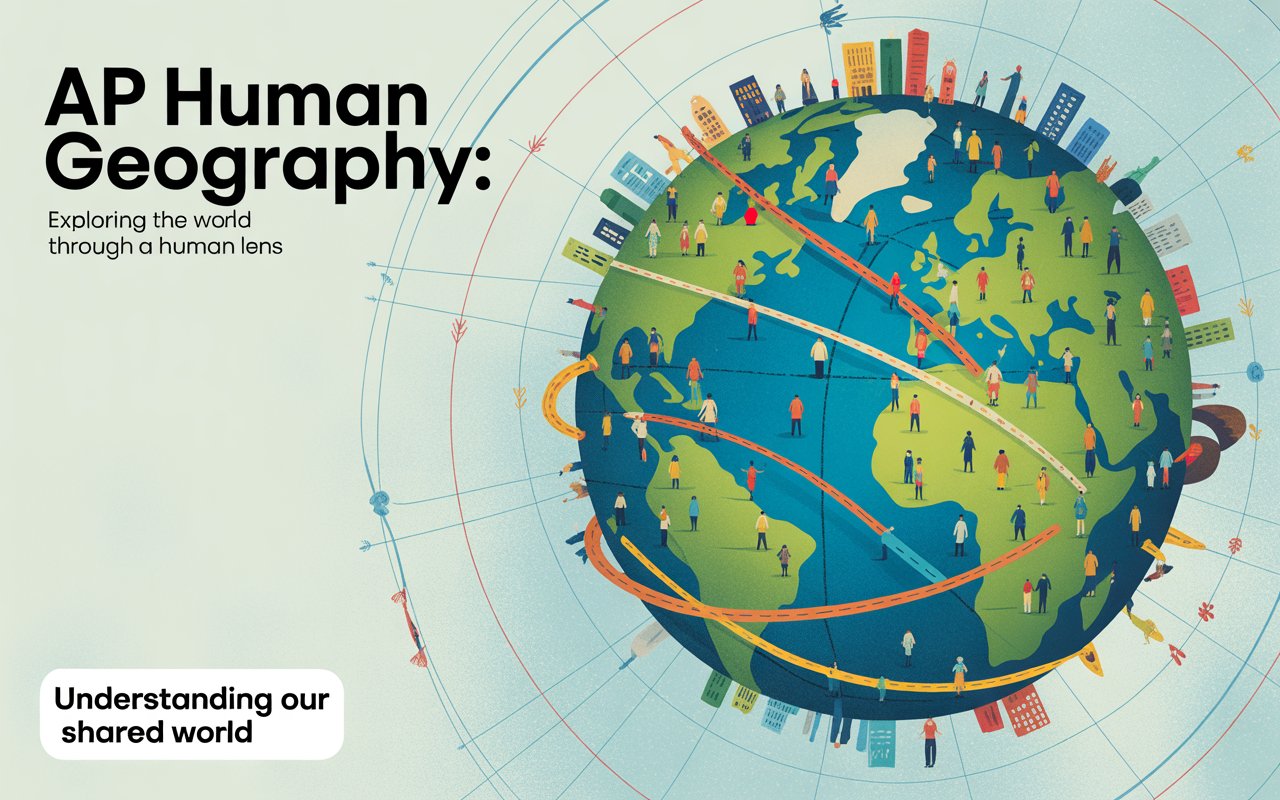
8. Urban Geography
Cities are like living organisms — they grow, evolve, and sometimes face decline. Urban geography examines:
-
Urbanization: The movement from rural to urban areas.
-
City models: Explaining how cities are structured (e.g., concentric zone model, sector model).
-
Gentrification: Revitalization of older neighborhoods, often changing their cultural and economic makeup.
-
Suburbanization and sprawl: How cities spread outward.
Take New York City: its structure reflects immigration waves, industrial growth, transportation networks, and economic shifts over centuries.
People and the Environment
9. Human-Environment Interaction
One of the central themes of human geography is how humans adapt to and modify their environments. This includes:
-
Agricultural systems and their impact on landscapes.
-
Resource use and environmental sustainability.
-
Climate change and how it reshapes human settlement patterns.
For example, coastal cities are adapting to rising sea levels, while arid regions innovate with water conservation technologies.
Modern Issues and Global Connections
10. Globalization and Cultural Convergence
In today’s world, cultures and economies are more interconnected than ever. Globalization accelerates the spread of ideas, technologies, and products, often leading to cultural convergence — where distinct cultural traits blend into shared global patterns.
However, this also raises questions: Are local traditions disappearing? How do communities maintain cultural identity in a globalized world?
11. Challenges in a Changing World
Human geography also equips us to analyze pressing global challenges, such as:
-
Urban overcrowding
-
Food security
-
Political conflicts over resources
-
Migration crises
-
Economic inequality
By understanding these issues geographically, we can design more effective policies and sustainable solutions.
Bringing It All Together
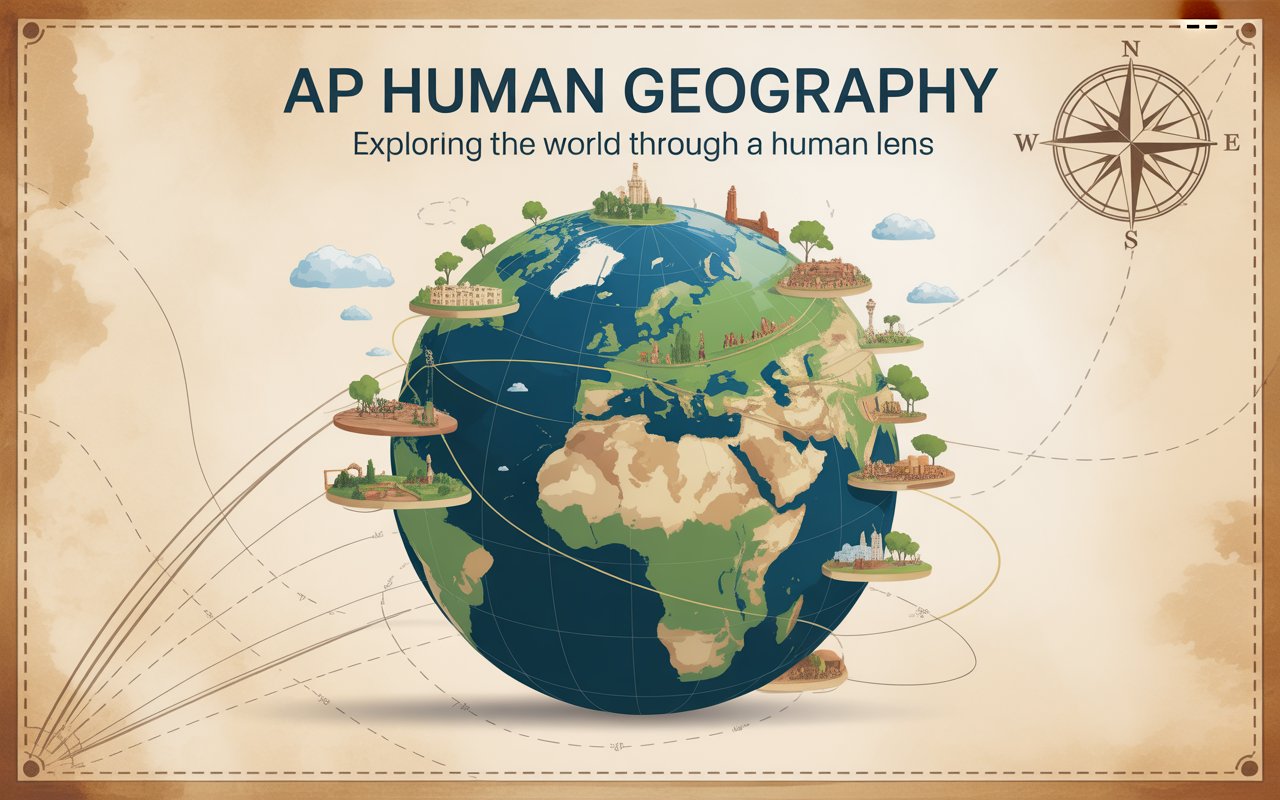
12. How AP Human Geography Prepares Students
This course doesn’t just prepare students for an exam — it develops critical thinking, global awareness, and the ability to connect seemingly unrelated ideas. Students learn to read the world like a story, noticing the invisible threads that connect human actions to geographic spaces.
Conclusion
AP Human Geography is more than a school subject — it’s a lens to view the world differently. It helps us understand why people settle where they do, how cultures evolve, how cities grow, and how global forces shape local realities. In a rapidly changing world, this understanding is more valuable than ever.
So the next time you look at a map, don’t just see countries and oceans. See stories — of movement, culture, power, and connection.
FAQs
1. What is the main goal of AP Human Geography?
The main goal is to help students understand the patterns and processes that shape human interactions with the environment and how these relationships create the cultural landscapes we live in.
2. Is AP Human Geography considered a difficult course?
It’s often seen as manageable for beginners because it introduces key concepts in a clear and structured way. However, success depends on critical thinking and applying concepts to real-world scenarios.
3. How can studying human geography help in careers?
It develops skills useful in urban planning, international relations, environmental science, data analysis, public policy, and education, among others.
4. What’s the difference between human and physical geography?
Physical geography deals with natural landscapes like mountains and climate, while human geography focuses on how humans organize space and interact with these environments.
5. How is globalization studied in human geography?
It’s analyzed through trade patterns, cultural diffusion, migration trends, and technological connections, showing how local and global processes influence each other.